
The Poster Problem
On provenance, what audiences feel without being able to name it, and why live music runs on something that can't be automated… thankfully…
A person who works in live music marketing wrote something online that I have been thinking about since I read it. He works for a venue called Audio in the Trees. He was describing a decision that happens constantly in his industry — bands are broke, venues are broke, designers are broke, so when a poster needs to be made, someone opens Midjourney or ChatGPT and generates something good enough. Money saved. Problem solved. Except, he wrote, it isn't.
'Because the models generating that artwork were trained on real artists. Often without consent. Often without compensation. So now we have musicians undercutting visual artists, both operating in the same fragile economic bracket, while the tools were built on scraped labour.'
And then: 'The audience can feel it. They may not know who made the poster. They may not care about the tool. But they feel when something was extracted instead of created.' It’s easy to dismiss as sentimental and I don’t think it is purely that. It is an observation about how human beings experience aesthetic objects, and it has practical commercial consequences.
The claim is not that audiences can identify AI-generated artwork. Most can’t, in controlled tests. The claim is that something registers — a texture, a quality of attention in the work, the presence or absence of the kind of specific decision-making that comes from a person who made deliberate, personal choices about what to include and what to leave out. Whether this is a real perceptual phenomenon or a post-hoc rationalisation of other signals is something to be considered carefully, but evidence from several contexts suggests it is at least partially real.
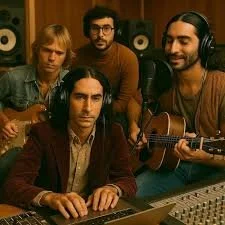
When The Velvet Sundown accumulated 1.2 million monthly listeners on Spotify, fans who grew curious about the band started examining the photographs. The images had that quality — specific to AI generation at its current level of development — of rewarding close attention by generating new questions rather than answering them. Instruments held at awkward angles. Background elements that dissolve into each other at the edges. It took a while… but the fans eventually saw it.(1) They could not always name what they noticed. But they noticed something.
When Emily Portman, a folk singer, discovered that a ten-track AI album had been uploaded under her name on Spotify, a fan had already messaged her to praise the 'new album' and assure her that English folk music was in good hands. Portman told the BBC: 'I'll never be able to sing that perfectly in tune. And that's not the point. I don't want to. I'm human.' The fan had experienced the album as a human artefact. Portman's response identified what was missing: the imperfection is not a defect. It is evidence of a person.
The poster problem is really that if a live music event's promotional materials are generated by AI from scraped creative labour, and if audiences can feel — even without being able to articulate — that something about the thing was assembled rather than made, then the promotional materials are working against the purpose they are supposed to serve.
Live music is, at its core, an argument that being in a room with human beings making something in real time is worth leaving your house for. A poster generated by an algorithm trained on images made by artists who were not compensated is delivering the opposite argument before the event has begun.
The taxi driver / ride share parallel the writer uses is apt in a way he may not have fully intended. When ride shares arrived, overnight 'anyone' could drive and earn. It was cheaper, more efficient, marketed as progress. The squeeze on taxi drivers was real. But ride share also created a different squeeze that took longer to become visible: the experience of being in a car with a driver who is being algorithmically managed down to fractions of a minute, who has no relationship with the city except as a route optimisation problem, who is not quite available as a human presence because the app has pre-empted every aspect of the interaction. This is not an argument against ride share. It is an observation that efficiency can come at a cost that is not captured in the price.(2)
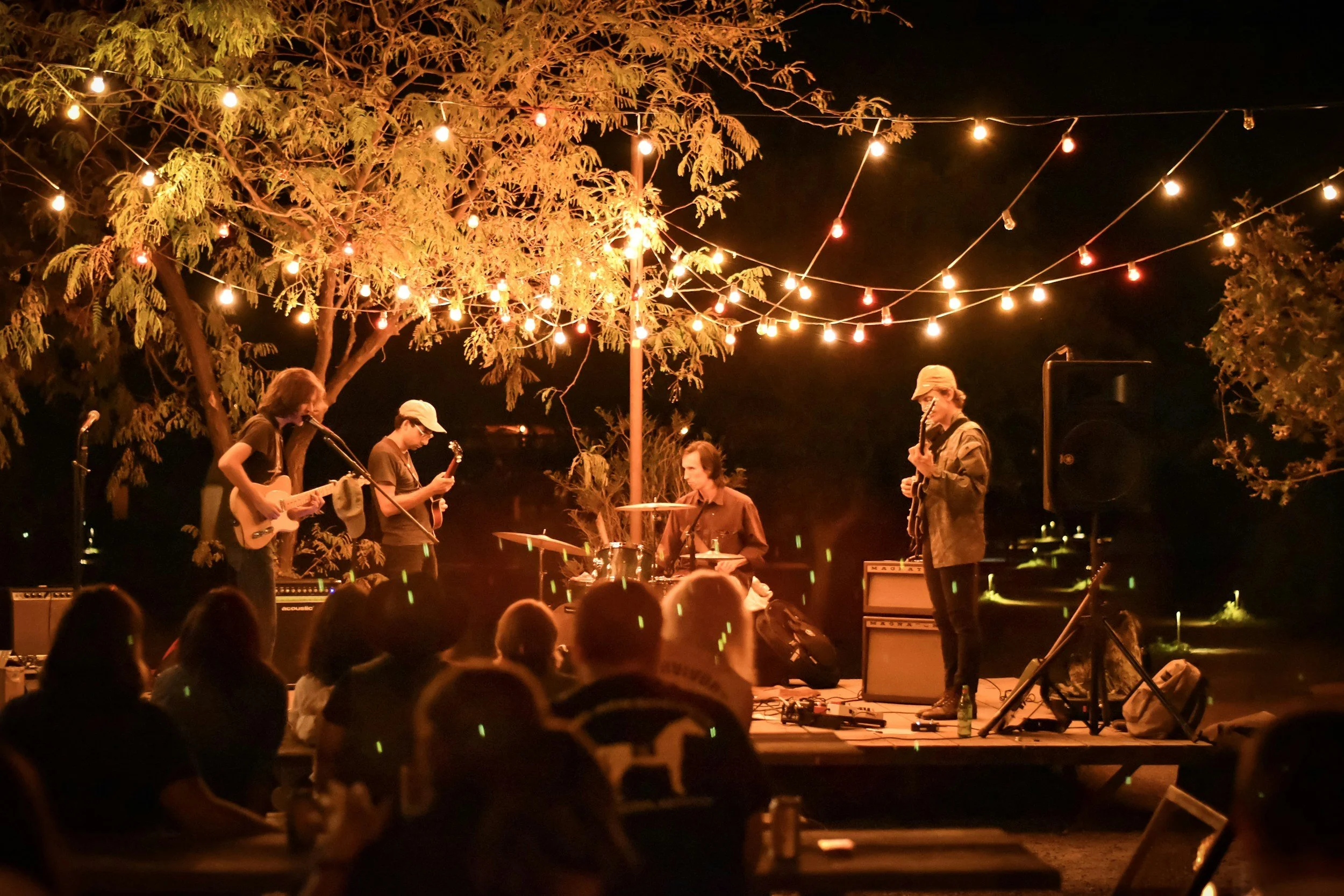
Live music has survived every technological disruption of the past century because it offers something that recording and streaming cannot replicate - the raw reality of presence. The fact that the musicians are in the room with you, that what they create is made in the moment and will not happen the same way again, that the experience is shared between people who are physically together. This is not just nostalgia - it is a value proposition that the streaming economy has, if anything, increased rather than diminished by making recorded music so abundant and frictionless that the irreplaceable quality of live music becomes more rather than less valuable by contrast. Or at least, we can hope so.
Provenance is the word the writer used. Where did this come from? Who made it? Under what conditions? With what respect?
These are not only ethical questions, though they are also ethical questions. They are questions about the texture of creative work that audiences have always answered — not always consciously, not always accurately, but consistently and in ways that affect what they choose to engage with and what they value.
The question of whether a poster was made by a graphic designer who knows the local music scene, who has opinions about the bands playing, or even by a band member, whose aesthetic choices reflect their own encounter with the music; or whether it was generated in thirty seconds by a tool trained on unconsented creative labour — this question has aesthetic consequences that end up as economic consequences, and ethical ones.
The live music industry is not going to solve the AI training data problem. It is not going to restore the visual arts economy that existed before generative image models. These are problems that require responses at a scale beyond what any individual venue or promoter can achieve. But the choice of whether to use AI-generated promotional materials is not only an economic choice. It is a choice about what kind of argument the venue is making about the value of human creative labour, before a single musician has played a note.
Audiences can feel when something was extracted instead of created. The live music event that surrounds itself with extracted materials is making a case for extraction before the people in the room have made the case for creation. These two arguments are in constant tension. The argument for creation is the only one that justifies the price of the ticket.
Notes
CBC News — Velvet Sundown and the AI band controversy, July 2025. https://www.cbc.ca/news/entertainment/musicians-ai-bands-streaming-1.7581400
Jeffory Simmons LinkedIn (Audio in the Trees) — live music marketing and the poster problem.
If you've made it this far, you probably care about where music is headed.
So do we — that's why we built something different. The Pack Music Co-operative is Australia's first musician-owned streaming platform: cooperative-governed, human-curated, and built on the radical premise that the people who make the music should own the infrastructure that distributes it.
Join the Pack — become an early adopter member, support our crowdfunding campaign, or lend your voice as an Ambassador: 👉 packmusic.au/join-the-pack
Back the campaign — every dollar goes directly toward getting us to launch: 👉 crowdfunding.startsomegood.com/thepackmusiccoop
Read our story — where we came from, why we built it, and what we believe: 👉 packmusic.au/who-we-are
Say hello — we genuinely want to hear from you: 👉 packmusic.au/contact