
The Oldest New Idea in Music
On cooperative models, start-up culture, and why your grandmother's ethics still work in the digital age
There is a particular kind of pitch deck that circulates in the start-up world, and if you have spent any time in incubators or accelerators, you know it by feel before you have read the first slide. It begins with a problem statement that is either genuinely serious or has been framed to sound that way. It moves through a market sizing exercise implying the opportunity is large enough to justify the ask. It arrives, with practised momentum, at the solution — which is, in almost every case, an application of the same commercial logic that produced the problem, implemented with a slightly different interface and a more compelling founder story.
I spent years in that world. Long enough to understand its fluency and to grow tired of it. Long enough to notice that the word 'disruption,' which started as a description of structural change, had become a synonym for extracting the same value from the same people through a newer mechanism. Long enough to understand that in start-up culture, the founder is frequently the product — packaged, pitched, and sold to investors the way artists are packaged, pitched, and sold to labels — and that the emotional logic of both transactions is remarkably similar: someone with less power gives up control of what they have made in exchange for access to distribution infrastructure they cannot build alone.
The Pack Music Co-operative began as a question about whether that trade was necessary. Eight years later, I believe the answer is no. Cooperative models are older, more tested, and more structurally honest than the alternative, and the evidence for this is available to anyone willing to look at it.
The immediate context for The Pack's founding was what happened to independent musicians in the decade following the consolidation of streaming, accelerated by the pandemic's obliteration of live income. Streaming had been sold to the industry as salvation from piracy — a legal, accessible model that would return revenue to rights holders and grow the market. What it produced, in practice, was a revenue model structured almost entirely around scale, in which artists who already had the largest global audiences received meaningful income and the rest received fractional cents distributed through a pro-rata system that was, and remains, mathematically incapable of sustaining the majority of working musicians.(1)
The data is consistent across multiple independent analyses: the median musician on major streaming platforms earns less from streaming than from a single modest live performance, and the income gap between the top fraction of streamers and everyone else is not closing. The pandemic removed live income — the primary revenue source for most independent artists — at the same moment that streaming was being promoted as the future of music economics. The combination was, for many, catastrophic.
Working in music advocacy through this period, what I found was that the response from the industry and platforms was essentially to wait for conditions to improve while arguing the fundamental model was sound. The artists most harmed by the model were also those with the least political leverage to change it. Independent musicians are individual contractors, in most cases, with no formal mechanism for influencing the terms on which their work is distributed.
The question The Pack started with was structural: what would it look like if the distribution infrastructure were owned by the people whose work it distributes? Owned by them, governed by them, with revenue distribution and platform decisions answerable to them through formal democratic process.
The cooperative model is not a new answer to this question. The Rochdale Pioneers established the first modern consumer cooperative in 1844, in response to exploitative pricing by mill owners — a context that maps onto the streaming conversation with uncomfortable precision.(2) Cooperative enterprises have operated at scale in banking, agriculture, retail, housing, and manufacturing for nearly two centuries. Mondragon, the Basque worker cooperative federation, employs over 70,000 people and generates annual revenues exceeding €11 billion. The cooperative sector globally represents a combined turnover of roughly $2.5 trillion and supports the livelihoods of approximately one billion people.
The cooperative model is persistently treated in start-up culture as a charming but impractical alternative to real business — the economic equivalent of a community garden, admirable in spirit but unlikely to compete with industrial agriculture. This treatment requires ignoring most of the available evidence. Cooperatives are not uniformly small, niche, or fragile. They are, in many sectors, the dominant form. The reason they are not dominant in the technology sector is that venture capital, which funds the majority of technology platform development, requires a return structure incompatible with cooperative ownership — and so the funding infrastructure for technology has, over several decades, actively selected against cooperative models regardless of their merits.
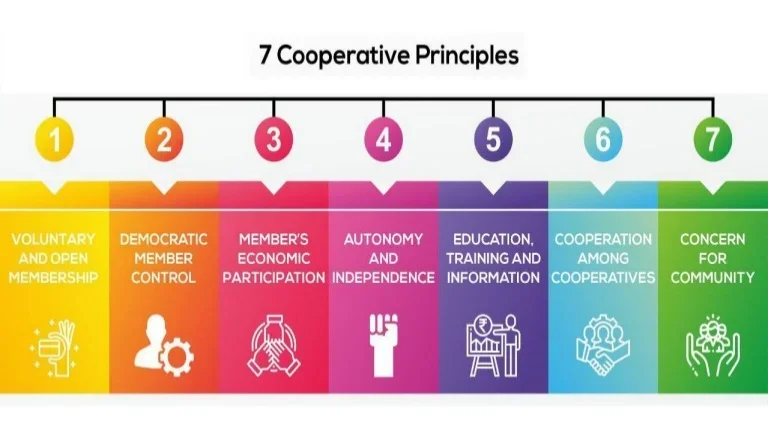
Platform cooperativism — applying cooperative governance principles to digital platforms — is a relatively recent theoretical and practical development, associated primarily with the work of Trebor Scholz and others at The New School.(3) The underlying logic is straightforward: the internet's capacity to organise distributed communities creates the conditions for cooperative ownership at scales previously impossible. The practical barriers to running a cooperative with members spread across a city, a country, or a continent are substantially lower than they were when cooperatives required physical quorum for governance decisions. Digital democracy does not solve every governance problem — verifying identity, managing participation at scale, preventing capture by organised minorities — but it removes the spatial constraints that limited earlier cooperative models.
What remains constant across cooperative forms is the governance commitment: one member, one vote, with the enterprise's priorities determined by its members rather than by external shareholders whose interests may diverge significantly from those of the people the enterprise is supposed to serve. In the context of a music platform, this means decisions about how revenue is distributed, how the recommendation infrastructure works, which artists are promoted, and what the platform does with its data are made by the artists and listeners who are members — not by a board answerable to investors with no particular stake in the health of the music sector.
I want to be honest about what this model does not solve, because the cooperative sector has its own history of overselling and underdelivering, and I have no interest in repeating that pattern.
The cooperative structure does not automatically produce ethical outcomes. It produces a governance arrangement in which the people most affected by the enterprise's decisions have formal power over those decisions. Whether they exercise that power well depends on the quality of the governance design, the commitment of the membership, and the ongoing work of maintaining democratic participation against the tendency of all organisations — cooperative or otherwise — to drift toward the convenience of whoever is most actively engaged in day-to-day operations.
The history of peer-to-peer music distribution is instructive. Napster's model was genuinely decentralised — a distributed network without central control, which was also what made it legally and ethically ungovernable. The power to distribute music without centralised oversight is also the power to distribute it without compensation to the people who made it. Decentralisation, in the absence of governance, does not produce fairness.
Spotify positioned itself as the corrective — legal, centralised, compensating rights holders — and in its early years was broadly understood as a better arrangement than unregulated piracy. What the model produced, at scale and over time, was a different kind of extraction: legal, opaque, and structurally biased toward the rights holders with the most leverage, meaning the major labels rather than the independent artists the platform claimed to be liberating. The lesson is not that centralisation is always bad or decentralisation always good. Structure without governance is not neutral. It expresses the values of whoever designed it, and those values are legible in the outcomes.
This is why The Pack's governance commitments are embedded in founding documents rather than expressed as aspirational values. The revenue distribution model — 70% to artists, 15% to sector development, 15% to platform operations — is not a policy that can be changed by a board decision. It is a constitutional commitment that requires member vote to alter.
The Pack is not trying to replace Spotify. Spotify has 600 million users, a decade of infrastructure investment, and licensing relationships with every major label. A cooperative platform based in Western Australia is not a competitive threat to that operation, and positioning it as one would be a category error.
What The Pack is trying to do is demonstrate, at working scale, that a different set of incentives produces different outcomes — and that the different outcomes are better for the specific community it serves: independent musicians, local music businesses, and listeners who want a direct relationship with the artists they support rather than the mediated, algorithmically managed relationship the major platforms provide.
The cooperative model makes the most sense at the local and regional level, precisely where the major platforms are least interested in operating. A platform whose revenue model depends on global scale has no particular incentive to develop deep relationships with a local music scene in Perth, or Hobart, or anywhere else where the music is culturally significant but the streaming numbers are modest. A cooperative whose members are the artists and listeners and businesses in that context has every incentive to do exactly that, because the value of the platform to its members is measured in the health of that scene rather than in global monthly active users.
Eight years is a long time to spend on something the dominant culture considers impractical. I have had the conversation enough times to know the shape of the scepticism: cooperatives work for small operations but can't scale, democratic governance is too slow for competitive markets, the model is structurally incompatible with the investment required to build platform infrastructure at any meaningful level.
These objections are worth taking seriously. They are also worth examining against the evidence, which shows cooperative enterprises operating at scale across multiple sectors, democratic governance producing better long-term outcomes than shareholder governance in a range of documented cases, and investment models for cooperative platform development that do not require surrendering democratic control to external capital.
What survives contact with the evidence is that the current streaming model is not working for the majority of independent musicians, was not designed to work for them, and designing something that does requires changing who owns the infrastructure.(4) The oldest insight of the cooperative tradition is that it is very difficult to build shared wealth without shared ownership. Two centuries of practice suggest this is correct.
The Pack's answer is yes, with the honest acknowledgement that will is necessary but not sufficient, that structure matters as much as intention, and that the work of building something genuinely different is harder and slower and less glamorous than any pitch deck suggests.
That, too, is something your grandmother probably knew.
Notes
Trichordist Streaming Price Bible; Music Business Worldwide royalty distribution analysis. https://thetrichordist.com/streaming-price-bible/
International Co-operative Alliance — history and principles. https://www.ica.coop/en/cooperatives/cooperative-identity
Trebor Scholz, Platform Cooperativism (Rosa Luxemburg Stiftung, 2016). https://rosalux.nyc/platform-cooperativism/
ICA World Cooperative Monitor — cooperative sector global data. https://monitor.coop
If you've made it this far, you probably care about where music is headed.
So do we — that's why we built something different. The Pack Music Co-operative is Australia's first musician-owned streaming platform: cooperative-governed, human-curated, and built on the radical premise that the people who make the music should own the infrastructure that distributes it.
Join the Pack — become an early adopter member, support our crowdfunding campaign, or lend your voice as an Ambassador: 👉 packmusic.au/join-the-pack
Back the campaign — every dollar goes directly toward getting us to launch: 👉 crowdfunding.startsomegood.com/thepackmusiccoop
Read our story — where we came from, why we built it, and what we believe: 👉 packmusic.au/who-we-are
Say hello — we genuinely want to hear from you: 👉 packmusic.au/contact