
Where Your Money Goes
On the pro-rata system, the user-centric alternative, and what $7 a month means when it's yours to direct
Here is how your music subscription currently works. You pay. Your payment goes into a pool with everyone else's payment. The streaming platform takes its cut, approximately 30%. The remaining pool is divided among all rights holders on the platform in proportion to their share of total global streams. If an artist accounts for 0.001% of all streams globally in a given month, they receive 0.001% of the pool. It does not matter how much you personally listened to them. Your subscription does not go to the artists you chose. It goes to whoever everyone else listened to the most, which, by any global measure, is not an independent Australian musician.
This system was designed by streaming platforms and negotiated with major labels. Independent artists had no seat at that table. The consequence for Australian listeners is specific: spend a month listening exclusively to independent Australian artists and most of your subscription fee still ends up with the artists dominating global stream counts. Your listening choices and your financial choices are structurally decoupled. This is the current business model. It is also, if you stop to think about it, a remarkable thing to have built and then described as a music discovery service.
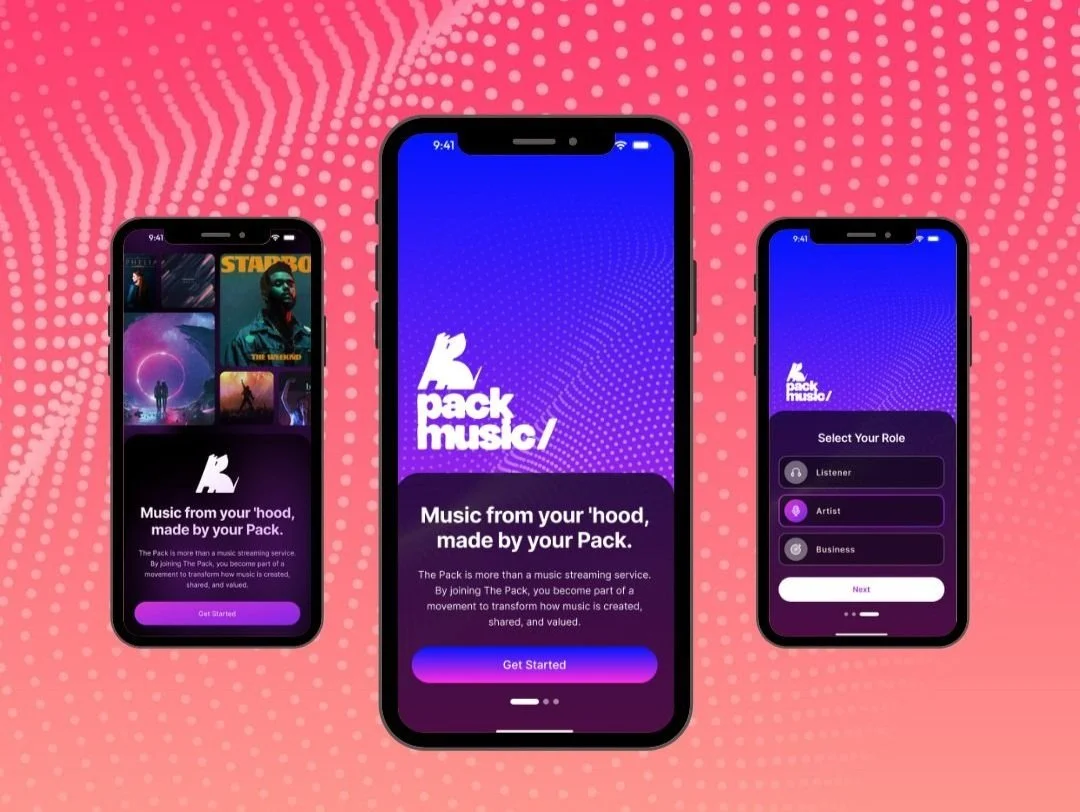
The Pack's payment model works differently. Your $10 monthly subscription breaks down as follows: $7 goes directly to the artists you actually stream, divided in proportion to your personal listening. $1.50 goes to sector development (grants, industry capacity building, emerging artist programs. $1.50 covers platform operations. If you listen to ten artists equally, each receives seventy cents from your subscription. If you spend the month with one band on repeat, they receive the full $7.
A user-centric model along these lines has been advocated by independent artist organisations globally for years and implemented in partial forms by Deezer and SoundCloud. Its consistent finding is that it benefits independent and niche artists at the expense of those who dominate global stream counts, distributing money in proportion to actual listening rather than aggregated listening. The major labels have consistently preferred the pro-rata model. The reasons for this are left as an exercise for the reader.
To understand what the scale difference means: ARIA reported that in 2024, Australia's total recorded music market generated $717 million in wholesale sales, with subscription streaming accounting for $509 million.(1) The majority of that flows offshore through major label distribution. Music Australia's Listening In research found that Australian artists earned $860 million in 2023-24 from all sources, royalties and live combined.(2) The Pack's projected $420 million annually in direct artist payments would be a substantial addition to what independent artists actually receive, paid without filtering through label recoupment or dilution by global stream competition.
A specific number makes this concrete in a way that projections don't. Under current streaming arrangements, an artist needs approximately 300,000 streams annually to earn $1,000 in royalties, at the standard rate of $0.003 to $0.005 per stream. To reach Australian minimum wage from streaming alone requires somewhere between 10 and 16 million streams per year. That is the number the platforms don't put in the press releases. It also explains why the overwhelming majority of working Australian musicians have a day job.
Under The Pack's model, 1,000 regular listeners (people who return to an artist's catalogue as a meaningful portion of their monthly listening — would generate thousands of dollars annually in direct payments, proportional to actual listening time. That is not 10 million anonymous streams competing in an algorithmic lottery. It is a thousand people who genuinely chose the music, and a payment system that honours that choice. The math of fan-supported local streaming is not just different from the math of global platform competition. It is from a different universe entirely, one where the artist doesn't need to go viral in San Francisco to pay rent in Fremantle.
The Music Australia research found that First Nations Australians showed particularly strong interest in a dedicated Australian streaming service.(3) The user-centric payment model has a specific implication here: when a listener chooses to stream First Nations artists, their subscription money flows to those artists directly. The platform's recommendation algorithm does not have to compete with global stream counts to surface Indigenous music. The listener's intent and the payment arrive at the same destination, which is a design choice the major platforms made differently, and which is worth noticing.

The Pack's model extends beyond individual subscriptions. Australia has approximately 100,000 businesses licensed through OneMusic to play music publicly (cafés, gyms, retail shops, restaurants, hairdressers). Business subscriptions at $50 per month would generate significant additional revenue while creating something the current streaming model doesn't: a reason for local businesses to actively discover and play local artists, because the payment goes to those artists in proportion to actual plays. Walk into a café in Broome. Hear a musician from Broome. The café's subscription goes to that musician. A payment system working as advertised. A business model that cares.
The case for user-centric payment is simply that the person paying for music should have their payment go to the music they choose to support. The pro-rata model makes a different choice: pool everyone's money and distribute it according to aggregate global popularity. If your musical taste runs to independent Australian artists rather than global chart-toppers, the pro-rata model converts your subscription into a subsidy for people who have never needed your subsidy and will never know you exist. The cooperative model makes a different choice. Your money follows your taste. The fact that this is not the default in any major streaming platform is a fact about who designed those platforms, and in whose interests.
Notes
ARIA — Recorded music continues to grow in Australia, March 2025. https://www.aria.com.au/industry/news/recorded-music-continues-to-grow-in-australia
The Music Network — Listening In report: Australian artists earned $860 million in 2023-24. https://themusicnetwork.com/australians-actually-love-homegrown-music-listening-in-report/
Creative Australia / Music Australia — Listening In research series, 2025. https://creative.gov.au/research/listening-research-series
If you've made it this far, you probably care about where music is headed.
So do we — that's why we built something different. The Pack Music Co-operative is Australia's first musician-owned streaming platform: cooperative-governed, human-curated, and built on the radical premise that the people who make the music should own the infrastructure that distributes it.
Join the Pack — become an early adopter member, support our crowdfunding campaign, or lend your voice as an Ambassador: 👉 packmusic.au/join-the-pack
Back the campaign — every dollar goes directly toward getting us to launch: 👉 crowdfunding.startsomegood.com/thepackmusiccoop
Read our story — where we came from, why we built it, and what we believe: 👉 packmusic.au/who-we-are
Say hello — we genuinely want to hear from you: 👉 packmusic.au/contact